Just when you thought that Reckless Abandon had abandoned their music, the band is back to practicing, and is sounding better than ever. The band has devoted their off time to work, school, and writing more songs. The new songs, just as the old ones, fit right to the heart of the band's philosophy and influences.
Lead singer Jef Park has been working on his song, "Everything and More," which tells the story of his relationship with his significant other. The smooth chord progressions and touching lyrics fit right into the soul of Jef's relationship. Some say that this song even beats the previous love song wrote by Jef, "Forever And A Day."
Along this way, though, Jef has seen many relationships fall with other couples, and this has inspired him to right yet another song. "Eyes Say Otherwise" is a sad and yet catchy song, fitting well with the band's musical roots. "I wanted to write a song that shows how strong the eyes can be, yet how easy it is to overlook the eyes of someone when you think that you are in love with them" Jef said in a recent interview. "This song still has work to do, but I'm liking the way it is going right now."

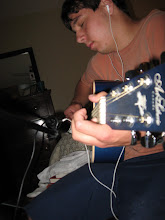
But Jef is not the only person to be writing music. Ryan Hampton, as seen on the left, even in his time working, doing school, and trying to keep a clean house, has also been writing music. "Just when I think I can not write anymore songs," says Ryan, "I come back and continue writing. I just can't help it."
Ryan has been working on "Calling in Life" for a while now, a songs that portrays his outlook to life, and how his songwriting allows him to see the world better. "I was just in bed thinking one night," says Ryan, "About all of my mistakes and how my faith in God seems to die away so easily, and I come to realize that this is what my songs are about. They help me put things in perspective, and at least make an attempt at telling others what I see through my eyes." As Ryan continues, "Sometimes these things I attempt at explaining are unexplainable, but yet somehow, whether you call it magic, power, love, or whatever, the unexplainable seems to make a little more sense through music, at least that is how it is with me." This is where the line of the song in the chorus, "Oh, can't you see this is my calling in life: to explain the unexplainable" comes in at. This poetic, literary, and emotional song reminds many of the poetic style of Ronnie Van Zant, lead singer of Lynyrd Skynyrd.
Ryan has also been working on his song "Drink to Remember" which has been called a "Presbyte-rian drinking song." "I don't want people to get the wrong idea of this song, though," says Ryan. "The song is funny, but it does have a driving point to it. I do not glorify drinking, much less getting drunk. I simply am saying that instead of drinking to forget about the past, as many do, we should remember the past when we drink." Ryan even quotes from Scripture at the beginning of the second verse, where it says "Jesus said 'Do this in rememberence of me,'" which was Jesus' words at the Last Supper where He took bread and wine. "I am simply wanting us to drink with joy to the blessings God has given us. Along the way in the song, particulary in the first verse, I show forth many facts of life that just make things seem unfair. But I turn them around in the chorus by basically saying, instead of drinking away the past in guilt, remember the past with joy. It puts things of today in perspective. One day you will probably miss these very times today. Life is a grand ole story, who's story book rests in Heaven."

Finally, Ryan has been working on the song "Why Does It Have To Be?" This songs, similar to Jef's song "Understanding," deals with a man who only wants to do what is right in helping somebody or some people. But in this case, it seems that his good intentions only go so far. In the first verse, a literary approach shows how someone tried saving someone and made thigns worse. The second verse deals with how this person gets out of the way, only to be cursed by the family of a fatal victim. "There is a fine in how we should help others, and just step back and let God take care of things. Certainly we want to be missional and get ivolved in someone's life, showing them the good news. But sometimes we have our own problems to work out, and rushing into something may make things worse," says Ryan. "That is what this song deals with. Where is that line? Why do our good intentions only go so far? Why would God give us wisdom to see when someone is in bad condition in need help, but not go ahead and give us the wisdom to be able to help them?"
There are more songs the band could be working on, but for now, they will stop with these. Ryan has in the back of his head songs "But Then Again (I could go home)," Finsish What I Started," and "One Philosophy." The first two songs have been songs that have already been written by Ryan in complete form, but the duo wants to wait a while before the finishing touches are added, and Jef takes over the vocals to the songs.

"We are in great shape" says Jef. "Just give us time and any attention you can, great or small, and you will find the lyrics relative to your life." The band looks to begin recording again perhaps sometime in the summer when school dies down, either by CGStudios Inc., or perhaps by purchasing their own recording studio.